


This month, as we mark Women’s History Month, I find myself returning to a short essay I first read years ago by Gloria Steinem. It has stayed with me — not because it is provocative, which it is, but because of the question at its center.
What would happen if men menstruated and women did not?
It is such a simple reversal. And yet, the more one sit with it, the more it reveals. The essay imagines how quickly something that has been treated as embarrassing or inconvenient would be reframed as powerful, disciplined, even heroic — if it belonged to those who traditionally held authority.
When I reread this essay now, I am less focused on the satire and more aware of the mirror it holds up. It is not really about menstruation. It is about how meaning is assigned. It is about how easily power reshapes narrative to protect itself.
So in this month of remembering women’s history, I am also interested in examining the frameworks that shaped it — and still shape us. All of us.
Sometimes a single question can help us see the architecture we’ve been standing inside all along. (Christine)
If Men Could Menstruate
What would happen, for instance, if suddenly, magically, men could menstruate and women could not?
The answer is clear — menstruation would become an enviable, boastworthy, masculine event:
Men would brag about how long and how much.
Boys would mark the onset of menses, that longed-for proof of manhood, with religious rituals and stag parties.
Congress would fund a National Institute of Dysmenorrhea to help stamp out monthly discomforts.
Sanitary supplies would be federally funded and free. (Of course, some men would still pay for the prestige of commercial brands such as John Wayne Tampons, Muhammad Ali’s Rope-a-dope Pads, Joe Namath Jock Shields — “For Those Light Bachelor Days,” and Robert “Baretta” Blake Maxi-Pads.)
Military men, right-wing politicians, and religious fundamentalists would cite menstruation (“men-struation”) as proof that only men could serve in the Army (“you have to give blood to take blood”), occupy political office (“can women be aggressive without that steadfast cycle governed by the planet Mars?”), be priests and ministers (“how could a woman give her blood for our sins?”), or rabbis (“without the monthly loss of impurities, women remain unclean”).
Male radicals, left-wing politicians, and mystics, however, would insist that women are equal, just different; and that any woman could enter their ranks if only she were willing to self-inflict a major wound every month (“you must give blood for the revolution”), recognize the preeminence of menstrual issues, or subordinate her selfness to all men in their Cycle of Enlightenment.
Street guys would brag (“I’m a three-pad man”) or answer praise from a buddy (“Man, you lookin’ good!”) by giving fives and saying, “Yeah, man, I’m on the rag!”
TV shows would treat the subject at length.
Excerpt from “If Men Could Menstruate” by Gloria Steinem, originally published in Ms. Magazine (October 1978). PDF accessed via xyonline.net
Invitation: Any woman/person could enter their ranks if only…?
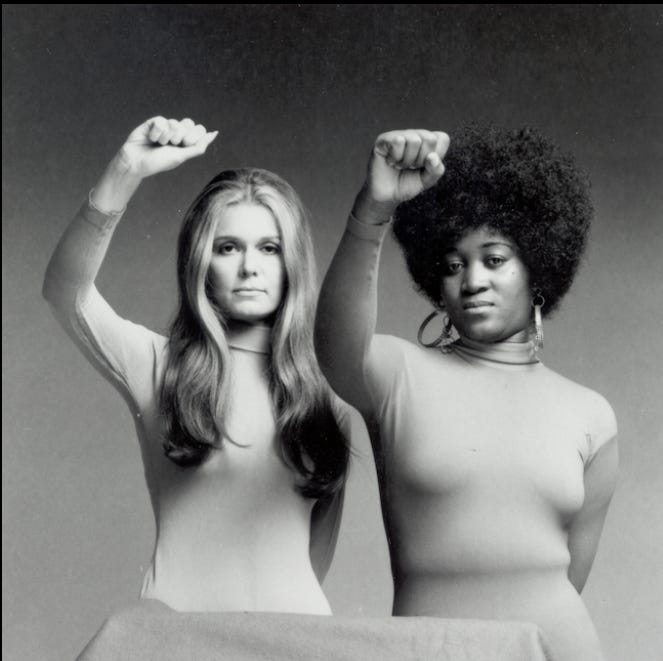
Photo Credit: National Portrait Gallery, Smithsonian Institution, Copyright© Dan Wynn Archive
Gloria Steinam is an American icon as a writer, activist, and one of the central leaders of the second-wave feminist movement in the United States. In 1972 she co-founded Ms. Magazine, creating a national platform for feminist journalism and public policy advocacy. At a time when women’s issues were either marginalized or filtered through male editors, Ms. created a national platform written by and for women. It brought topics like domestic violence, reproductive rights, workplace discrimination, and sexual harassment into mainstream public conversation. The magazine did not simply report on the women’s movement; it helped shape and legitimize it.
Her essays, including “If Men Could Menstruate” and the collection Outrageous Acts and Everyday Rebellions, The Truth Will set you free, but First It Will Piss You Off, blend sharp satire with political analysis, challenging cultural assumptions about gender, power, and equality. Over decades, she has remained a leading voice for women’s rights, reproductive freedom, and social justice.
If you are enjoying The Community Table and would like to support our work consider making a donation. While the offerings on the Community Table will always be free - we appreciate any support you can provide to continue helping us set the table for creating community.
We will meet for the Community Table every Monday at 4:30 pm or 8:00 pm (EST) - Go to our calendar at this link for details: https://courageouscommons.com/events/
There is an amazing video recording of the play about Gloria Steinem's life on PBS called "Gloria: A Life." I recommend it to everyone. I knew little of her family, her growing up, her choice of career as a journalist when few women entered this male-dominated field. While she's known as a feminist and activist, she is also a journalist, a writer -- and her skill and wit are evident in this essay.
A few years ago Gloria and Alice Walker spoke at an event in Santa Fe and I bought the very last ticket available at the venue. I was one of a handful of men there. One can imagine, they took down the house and certainly inspired me and the sea of young and older women in the audience that night. Here's to Gloria Steinem, Alice Walker, and all women who seek to lift women and all of humanity up.
Ah, sarcasm. The best use of words to flip the script and prove the point.