


For our June Americans Who Tell the Truth feature, we chose Dennis Kucinich because he has spent a lifetime holding onto ideas that many people considered politically inconvenient: peace, public good over private profit, environmental responsibility, and the belief that government should serve ordinary people, not power. Whether people agreed with him or not, Kucinich developed a reputation for saying what he believed plainly and standing by it, even when it cost him politically.
What stays with us is not simply his career, but his persistence. Again and again, he returned to public life guided by the same core convictions: opposition to war, care for the planet, healthcare as a human right, LGBTQ rights, and the belief that compassion belongs in politics. In a culture that often rewards performance over principle, there is something striking about someone willing to keep speaking about peace, tenderness, and human interdependence without apology.
Enjoy Dennis Kucinich’s wisdom below.
“Mr. Speaker, we make war with such certainty, yet we are befuddled how to create peace. This paradox requires reflection if we are to survive. Making and endorsing war requires a secret love of death, and a fearful desire to embrace annihilation. Creating peace requires compassion, putting ourselves in the other person’s place, and all of their suffering and all of their hopes and to act from our heart’s capacity to love, not fear.”
Dennis Kucinich, at this link by Robert Shetterly
Invitation: “For me, creating peace requires…”
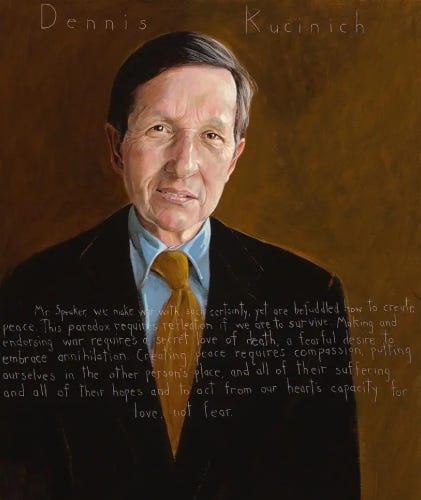
Portrait used with permission from Americans Who Tell the Truth
Our friends at Americans Who Tell the Truth shared this about Dennis Kucinich:
“Dennis Kucinich, former Democratic congressman from Ohio and two-time candidate for president, is an advocate for peace and a greener, healthier world. That he has carved out a successful political career holding true to these values is a remarkable achievement.
Kucinich’s early life and career were lessons in persistence and hard work. He grew up in a large family that was constantly on the move, searching for affordable housing; occasionally they had to live out of the family car. Kucinich began his political career by running for Cleveland city council while he was still in college. In 1977, he became Cleveland’s youngest mayor at the age of thirty-one. His term was controversial. Kucinich refused to sell the city’s publicly owned power company, Municipal Light, a decision so unpopular at the time that a contract was taken out on his life. It was years before the city recognized that Kucinich, in standing up to the banks and big businesses that had tried to force him to privatize Municipal Light, had made the right decision.
Following the “Muny Light” episode, Kucinich became a political pariah. But he began his political career over, starting again as city councilman, then moving to the state senate, and finally to the U.S. House of Representatives in 1996. He remained in office until the end of 2012.
As a representative, Dennis Kucinich made a point of knowing and working for his constituency. He voted against the NAFTA agreement and the Patriot Act. He opposed the 2003 invasion of Iraq and continued to advocate a withdrawal of troops from Iraq. He supported gay rights, including same-sex marriage, and a universal health-care system. Kucinich also supported have the Kyoto Protocol and domestic policies that address global warming and other conservation issues.
When he ran for president, Kucinch said that, if elected, he would create a Department of Peace, announcing that he was “going to let the rest of the world know that the days of America trying to be a nation above nations is over. We have to quit trying to dominate other countries, and we have to step out of our isolation and into the brotherhood and sisterhood of all people. . . . We have to be ready to take the lead, but we need to have harmony with other nations.” As a candidate, Kucinich also said, “One of my proposals is to have millions of homes with wind and solar technologies. . . . the role of utilities will change dramatically because it’s not going to be a centralized approach to energy production. . . . I want to see, eventually, all the homes in this country have the option of that technology. In turn, you can create millions of jobs building alternative technologies.”
Kucinich´s ideas about how government can best serve the people do not always follow political party lines; often he stands alone, as when he proposed articles in 2007 to impeach Vice President Dick Cheney, charging him with misleading America into war. He keeps a small copy of the Constitution with him at all times, to remind himself of Congress’ commitment to upholding its principles. In June 2008, Kucinich presented thirty-five articles of impeachment to Congress; one month later, realizing that number was too large to deal with at once, he introduced a single article to impeach President Bush for “Deceiving Congress with Fabricated Threats of Iraq WMDs to Fraudulently Obtain Support for an Authorization of the Use of Military Force Against Iraq.”
At the age of seventy-seven—still committed to his long-standing principles—Kucinich ran as an independent candidate for Ohio’s 7th Congressional District but lost to the incumbent. The heart of the matter, for Dennis Kucinich, is believing that “peace means being in harmony with nature.” This has shaped his life and his work for a greener and more socially just America.”
If you are enjoying The Community Table and would like to support our work consider making a donation. While the offerings on the Community Table will always be free - we appreciate any support you can provide to continue helping us set the table for creating community.
We will meet for the Community Table every Monday at 4:30 pm or 8:00 pm (EST) - Go to our calendar at this link for details: https://courageouscommons.com/events/
I am grateful for the partnership between "Americans Who Tell the Truth" and Circles of Courageous Commons. Here's to Dennis Kucinich, the June Courageous Citizen.
"Creating peace requires compassion, putting ourselves in the other person’s place, and all of their suffering and all of their hopes and to act from our heart’s capacity to love, not fear.” Dennis Kucinich.