


The Anti-Ableist Manifesto
 “Once you’ve met one disabled person, you’ve met one disabled person.”

Happy Disability Pride Month, and this year it feels especially close to home.

As I write these words, my husband, Sam, is in his office preparing for his comedy show tonight. He's wrestling with a familiar question: How do I introduce the audience to how I became blind later in life? How does one work an optic nerve stroke into a punch line?

I don't know.

Neither does Sam.

He's still sitting in his office, trying to figure it out.

What I do know is that awareness is built in these small places.  It begins with making room for people who's lived experiences are different from our own instead of assuming that we understand them.

At Circles of Courageous Commons we believe that community grows stronger when everyone is included. Every perspective enriches all of us. As we celebrate Disability Pride Month, I thought of Tiffany Yu's The Anti-Ableist Manifesto. She challenges us to reevaluate our language as one way to create spaces where access, belonging, and compassion are woven into the fabric of our communities. (Christine)

Metaphors like “falling on deaf ears” to describe a statement that is ignored or “the blind leading the blind” to describe a directionless effort are harmful because they carry negative connotations. In an Instagram video, speaker and DEI consultant Catarina Rivera demonstrates how she leads her friend, accomplished author and activist Haben Girma, on the dance floor. As both women sway in rhythm, Rivera explains in a voice-over, “Being blind doesn’t mean being ignorant. Haben and I think we should all get rid of this ableist phrase because the blind leading the blind can be quite fabulous.”

“It’s just a metaphor! I don’t mean it seriously,” someone might say. But what does it mean when someone chooses to make light of terms that describe and make assumptions about the lived realities of disabled people? It demonstrates that they don’t take our concerns seriously.

It might seem difficult, even tedious; to make a conscious decision to change the way we’ve been speaking for years, but this interruption to our personal thought patterns is part of our anti-ableist work. Luckily, language is fluid and ever changing, and there are so many alternatives we can make use of to express ourselves in creative ways.
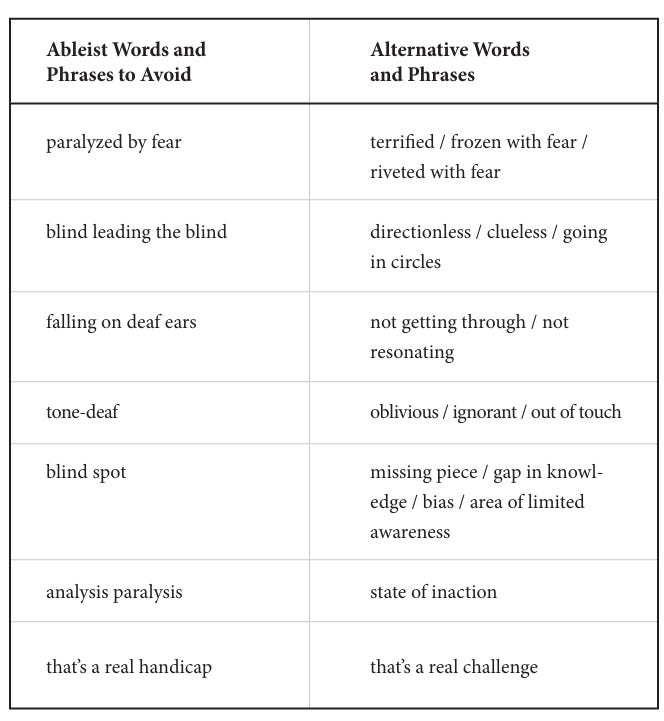
Ableist Words and Phrases to avoid chart found in The Anti-Ableist Manifesto, p. 22
By Tiffany Yu, found at The Anti-Ableist Manifest.
Invitation: “It might seem difficult to change …”
A Commons Practice
We believe no one is meant to walk alone.
Today’s reflection is just the beginning. Community happens when we gather to listen, reflect, and learn from one another.
Our Community Tables are free online conversations where everyone is welcome.
→ Join use at an upcoming Community Tables.

The original Disability Pride Flag designed by Ann Magill in 2019

Disability Pride Flag designed by Ann Magill in 2021
Disability Pride Month is observed every July to celebrate disability identity and community, mark the anniversary of the Americans with Disabilities Act (ADA), and push for full inclusion in everyday life. The 2026 theme is “The World Works Better With Us.”
Each color stripe has a meaning:
Red - physical disabilities
Gold - neurodiversity
White - invisible disabilities and disabilities that haven’t yet been diagnosed
Blue - emotional and psychiatric disabilities, including mental illness, anxiety, and depression
Green - for sensory disabilities, including deafness, blindness, lack of smell, lack of taste, audio processing disorder, and all other sensory disabilities
The faded black background mourning and rage for victims of ableist violence and abuse. The diagonal Bband cuts across the walls and barriers that separate the disabled from society, also representing light and creativity cutting through the darkness.
The information above was retrieved from The ARC.
Tiffany Yu is a disability advocate, entrepreneur, and founder of Diversability, a global community dedicated to advancing disability pride, leadership, and inclusion. She is the author of The Anti-Ableist Manifesto: Smashing Stereotypes, Forging Change, and Building a Disability-Inclusive World and serves on the National Institutes of Health's National Advisory Board on Medical Rehabilitation Research. Recognized on the 2025 Forbes Accessibility 100 list, Yu is a sought-after speaker and content creator whose work encourages individuals and organizations to build more inclusive communities.
Find a disability pride month event in your state by visiting the ARC.
If you are enjoying The Community Table and would like to support our work consider making a donation. While the offerings on the Community Table will always be free - we appreciate any support you can provide to continue helping us set the table for creating community.
We will meet for the Community Table every Monday at 4:30 pm or 8:00 pm (EST) - Go to our calendar at this link for details: https://courageouscommons.com/events/
July Courageous Citizen
Dr. Paul Farmer
For our July Americans Who Tell the Truth feature, we chose Dr. Paul Farmer because he spent his life living into the belief that we have a moral responsibility to accompany those who suffer. He didn’t simply talk about equity. He embodied it. Whether someone lived in a remote village or a place forgotten by the rest of the world, he believed no one should be beyond the reach of care.
https://americanswhotellthetruth.org/portraits/dr-paul-farmer/

Thank you Circles of Courageous Commons for lifting up Disability Pride Month and for sharing "The Anti-Ableist Manifesto" by Tiffany Yu. When I was in fifth grade my Mom lost her eyesight, She went to the Little Rock School for the Blind in Arkansas for 3 months to learn braille, mobility using the cane, and living skills to adapt as a blind person. The language that Tiffany Yu cautions us against, the phrase "The blind leading the blind" is certainly one that was undoubtedly hurtful to my Mom, and it was certainly hurtful to me when I heard it after Mom lost her eyesight. This manifesto has much to teach us.
I appreciate the alternate phrases. I will say, as a professional musician, there truly are people who can’t hear pitches and/or can’t match pitches vocally. I will honestly ask here for an alternative phrase other than tone deaf to describe this.